How GamStop Self-Exclusion Works and Why Offshore Sites Stay Reachable

Updated August 2026
Licensed
Available in GB
Fast payouts
18+ Only
How GamStop Self-Exclusion Works and Why Offshore Sites Stay Reachable
Last updated: Reading time: 7 min

If you have ever wondered why a single GamStop registration can lock you out of hundreds of UK gambling sites at once, yet a casino licensed in Curaçao still loads as if nothing happened, the answer lies in where the block actually sits. GamStop is not installed on your phone or laptop. It works through the operators themselves, which is exactly why some sites are caught by it and others never see it at all.

Understand what GamStop actually is before anything else

GamStop is the United Kingdom’s national online multi-operator self-exclusion scheme. It is run by The National Online Self-Exclusion Scheme Limited, usually shortened to NOSES, a not-for-profit body, and it launched in 2018. When you register, you self-exclude from every online gambling site and app run by companies licensed by the UK Gambling Commission, and you do it with a single request rather than contacting each operator one by one.

You choose how long the exclusion lasts: six months, one year, or five years. Once you confirm, the exclusion activates within 24 hours and cannot be undone for the period you picked. That last point trips a lot of people up, and it is covered in detail on the page about the legitimate way to remove yourself from GamStop, because the removal process is deliberately slow and only kicks in after your chosen period ends.

Three self-exclusion periods of six months, one year and five years shown as a timeline

The scheme exists to give someone a way to make one binding decision that protects them across the whole regulated market. Before it existed, a person could exclude themselves from one site and simply open an account somewhere else minutes later. GamStop closed that gap for the licensed sector, and it is genuinely effective within that sector. The complication is what counts as the licensed sector, and that is where the structure of the block becomes important.

See why the block lives with the operator, not your device

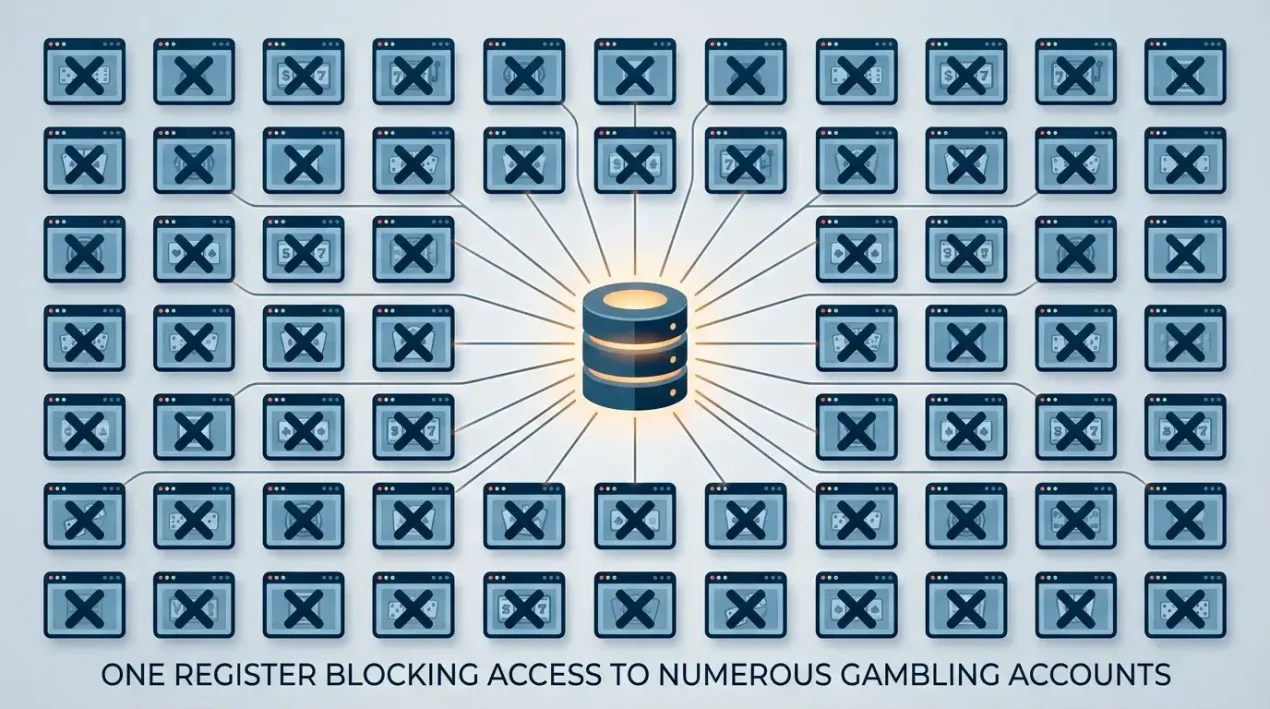
The single most useful thing to grasp is that GamStop is operator-side, or server-side. Nothing is downloaded to your computer or phone. Instead, the scheme maintains a central database of people who have self-excluded, and every UK Gambling Commission licensee is required to check against that database.

Here is the sequence in practice. When a registered person tries to open an account or log in to a UKGC-licensed site, the operator queries the GamStop database with that person’s details. If there is a match, the operator blocks access. The decision and the enforcement happen on the operator’s servers, not on the player’s hardware. This is the structural reason a casino that has never connected to GamStop simply cannot see your exclusion, because the check is something the operator performs voluntarily as a condition of holding a UK licence.

Diagram of an operator server checking player details against a central self-exclusion database

Think of it less like a lock on your front door and more like a guest list held by every venue in a single town. If a venue belongs to the association that shares the list, it turns you away. A venue in the next town that never joined the association has no list to check, so it lets you in. The list is real and binding for members, but it has no reach beyond them.

Trace why offshore casinos sit outside the scheme entirely

Participation in GamStop is mandatory only for UK Gambling Commission licensees. It became a licence requirement for online operators from 31 March 2020 under Social Responsibility Code Provision 3.5.5 of the Commission’s Licence Conditions and Codes of Practice. In 2024 the same provision was extended so that operators making and accepting bets by telephone and email also had to participate, in force from 1 April 2024.

That phrasing matters. GamStop is not a universal law that binds every gambling website on earth; it is a condition attached to a UK licence. A casino licensed solely offshore, most often in Curaçao and increasingly in Anjouan, holds no UK licence, so it is under no obligation to connect to the database and, in practice, never does. The player is not blocked there because the offshore operator has nothing to check against. If you want the legal angle on what this means for you as a player, the page on the player’s legal position in the UK sets it out without the usual hand-waving.

Map-style illustration contrasting a UK-licensed operator inside the scheme with an offshore operator outside it

One more nuance worth flagging. Since the 2023 gambling White Paper, the Commission has gained stronger powers to disrupt the so-called black market, including working towards IP-blocking of unlicensed sites that target British consumers. So while offshore operators are reachable today, the regulatory direction of travel is towards making access harder, not easier.

Distinguish GamStop from device-level blocking tools

A common point of confusion is the assumption that GamStop blocks the device. It does not, and that misunderstanding leads people to expect protection they never had. Device-level tools are a separate category and work in the opposite way.

Software such as Gamban and BetBlocker installs on your phone, tablet or computer and blocks gambling sites and apps at the device, regardless of who licenses them. Because the block lives on your hardware rather than on an operator’s server, these tools can reach offshore sites that GamStop never touches. They are not perfect; a determined person can use a different device. But for someone genuinely trying to stop, layering a device-level blocker on top of GamStop closes much of the gap that offshore sites otherwise leave open.

Smartphone with a shield icon beside a server cabinet with a barrier icon, contrasting device-level and operator-level blocking

GamStop
Operator-side. Blocks UKGC-licensed sites only. One registration covers the whole regulated market. Cannot reach offshore operators.
Gamban / BetBlocker
Device-side. Blocks gambling sites and apps on the device where installed, including offshore ones. Must be installed on each device.

The practical takeaway is that the two approaches are complementary rather than interchangeable. GamStop handles the licensed market comprehensively; device-level software handles the hardware. Neither one alone covers everything, which is part of why the official support network bundles them together.

Apply the mechanics to your own situation

If you registered with GamStop and are now finding that offshore casinos still let you in, that is not a loophole anyone built deliberately; it is a direct consequence of where the block sits. The scheme was designed to cover the operators it could compel through licensing, and it does that job well. It was never able to compel a company that does not hold a UK licence.

Person at a desk pausing thoughtfully in front of a closed laptop, suggesting reflection before a gambling decision

Knowing this changes the question you should be asking. The useful question is not how to get around GamStop, which the scheme is built to prevent during your chosen period, but whether the protection you set up is doing what you intended. If it is not, the answer is usually to add a device-level blocker and to read up on the official removal process for when your period ends, rather than to seek out a site the scheme cannot see.

This material was created by the Casino Not On GamStop team.

Related posts